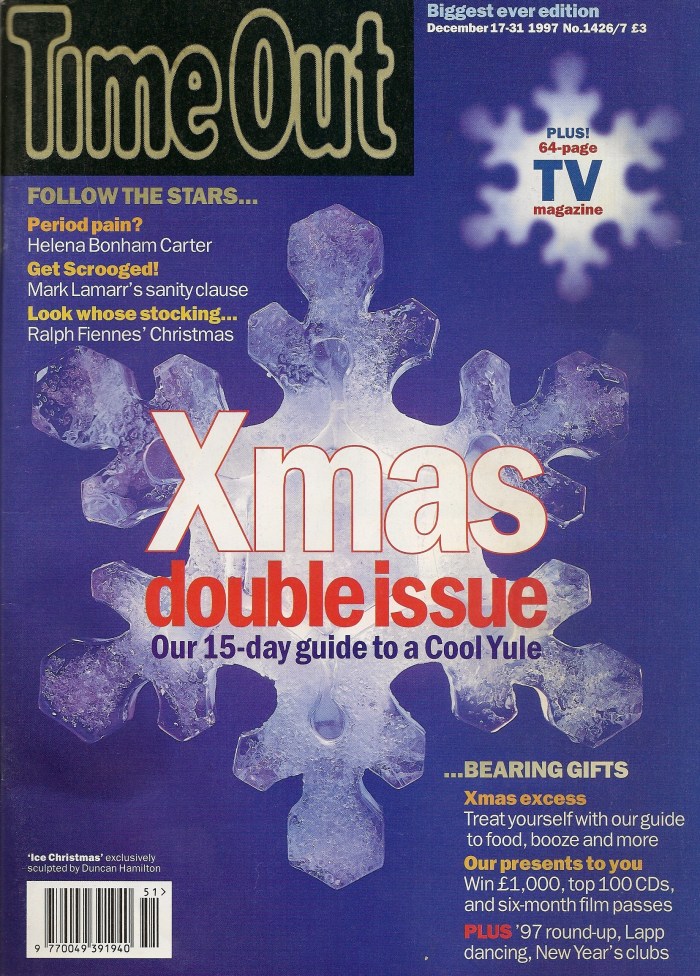
For the slightly cynical there is always the ironic saying, “Christmas comes but once a year, thank Christ.” But should we be cynical? On the one hand, we are bosomed with friends and family, eat and drink, fight: it sounds like a good night out. On the other hand, people have such ridiculously high expectations that presents and decorations will create an atmosphere, and enforce jollity.
I am too-frequently told that I am “a bit of a Scrooge”. My stock response to this is to explain patiently that I refuse to engage with Christmas because I am not religious, I have no children, and I would rather go to see friends and relatives when the trains are running. If in a properly cynical mood, I may add that it does not appeal to me to be locked in a house with people I would not want to see the rest of the year, with no escape (who’s driving?) Although these have merit as lines of argument, they are convenient easily digestible sound bites that make a point without having to go into detail. Rhetoric. They are flippant and lazy: a way of avoiding proper explanation that will likely confuse and, potentially, get me into an argument. In truth, I have deep-rooted reasons for not engaging with Christmas.
Firstly, at source, Christmas is about the seasons and nature, not religion or toys or (etc).
There is a reason Christmas is on the solstice. Some may exclaim, “Ah, pagans!” at this point, but that would be an error; as talk of paganism as the root of Christmas is just replacing one religion with another. I am talking about the turning of the seasons, and the natural cycles of the world on which our calendar is based.
Christmas is at the end of autumn, turning into winter, in the northern hemisphere of Europe (which is where the festival originated). In olden times in an agrarian society, the harvest would have been taken in and all the little odds and ends to wind-down the farm done; and you would have a large store of food following the harvest, much of which is perishable and some excess. So, with nothing to do at the time of year, with the farm effectively shut down, you would feast on the perishables before they went off; and you would eat the excess, which would have the helpful side-effect of putting on blubber to fatten you up for the cold days of winter. Beyond the practical considerations of food production, Christmas also has psychological roots and effects related to the seasons. You gather round – with your local village in times past – to commune before you lock yourself away in front of the hearth-fire through the dank days of winter, hidden from the cold, wind and rain outside, cut off from human society. In short, Christmas is the post-harvest feast, a bingeing hurrah as the misery of Winter encroaches.
But what is the purpose of such a feast now, when we have refrigeration and central heating? Social, perhaps? If society treated Christmas as a straightforward feast, I could join in along with the rest as I like a good party; but this is not what happens. Which brings me on to …
Secondly, Christmas is a ritualistic social festival, which makes little sense and has weird trimmings that, frankly, I do not particularly enjoy.
If others derive pleasure from it, then they are more than welcome to go ahead; but why must they pester and antagonise me about it? I do not tell people that they should not participate in Christmas or that it is rubbish – in fact, I think it serves a valid social function in that people come together with others they would not normally see, bonding society in its way – but proponents of Christmas are very quick to tell me I am a Scrooge or grumpy if I decline an invitation to the ritualised Xmas work lunch or refuse to waste hours of my time shopping for presents that people do not want (etc).
As such, I become victim to those who use the Scrooge-derived exclamation ‘Bah! Humbug’ (despite my attempts to appropriate it). Telling someone they are a Scrooge is used to reinforce the social norm, i.e. if you fail to become involved then you are grumpy by default, and therefore it is a way of subtly criticising someone and a form of intimidation to make people join in, even if they do not feel inclined to, as people are meant to be happy at Christmas (says the suicide rate). They insult you and your Scroogeness with a nudge and a wink, of course. This is why you see people from offices who are drunk at said time of year but are never drunk during the rest of the year – I used to be critical of these people, saying that I didn’t need the excuse of Christmas to get drunk, but now I see the immense social pressure to conform they are under. So, ‘Bah! Humbug’ is a way by which the Christmas-freaks gently call you a party-pooper and pressure you into engaging in THEIR ritual.
But Christmas is a hide-bound, ossified, anachronistic social RITUAL on a massive scale, and it makes little sense – for example, some starter questions: what is the purpose of a xmas card? and why do we take in a tree for two weeks? and put tinsel on it? is it not a needless holocaust of trees, including those used to make all the cards and wrapping paper? Christmas has developed peculiarly over a long period of time and been co-opted by vested interests until it has become blindly mechanistic on a societal basis, with nonsensical trappings. It is like, in a couple of thousand years, the Glastonbury music festival being celebrated on a culture-wide basis (you can already see the rituals developing at that festival actually, and Glastonbury Tor has been co-opted as the place of pagans and/or Christ).
What should be a pleasant feast at Christmas has thus become a fraught ritual, when people do things that make no sense and lead to stress. Am I not allowed to sensibly opt out from the social madness without being insulted? Is my only limited and poor defence to insist that I am a bit of a Scrooge and beat others to it? Do people REALLY enjoy the going-through-the-motions of it all? These and many other pertinent questions.
Suffice to say, I will not readily allow myself to be manipulated and coerced into illogical, ritualistic behaviour just because ‘everyone does it’.
If you do enjoy Christmas, then fine. But please do not stress or get into fights. Enjoy the food and company, which is what it is about at root. In the end, in the grand scale of things, it is very unimportant unless you invest it with significance yourself. But, above all, do not pressurise, or be rude to, those who do not wish to join in: such behaviour is not very Christian (or, perhaps, it is).
By the bye, I have been to the home of Saint Nicholas (translation: Santa Claus) which is a secluded and protected village and, here’s the rub, a beach in Turkey. How he became an inhabitant of the North Pole and the route(s) of appropriation leading from a balmy climate to the frozen north are mysterious to me, but someone must have researched and worked it out. Personally, I cannot be bothered working it out, but it is symbolic of the distorted origins of the modern festival.
At least Christmas has some natural, physical basis in the turning of the seasons; but new year is an even more illogical ritual to me, as it is an arbitrary conceptualisation.
The saying ‘happy new year’ is simply a rehearsal of what people have been trained to say by societal conditioning, and I have to restrain myself from replying “good boy” in tribute to the dogs Pavlov used. Do people understand the implications of what they are saying? To me, it is an automated greeting. Do not think I am getting curmudgeonly in my old age. I don’t really care. But I am curious about what this mass automatism says about the general state of learning and the human condition.
I am talking about the peculiar social conception of time (as opposed to the actual concept of time).
A year is based upon a single rotation of the earth around the sun, or the solar calendar. Therefore, any ascription of the ‘start’ or ‘end’ of the year is purely arbitrary, as the year is based on a celestial circle or loop, i.e. something with no start or end. Different cultures have different dates for new year, choosing different points on the circle to identify a start / end. Some cultures have been known not to conceptualise the new year at all; which can be understood if you conceive of the year as a cycle, not linear. As such, it can be seen that the essence of new year is a socially accepted agreement on how we should measure time, when the year starts and ends, which requires a (misguided) cultural conception of time as its foundation.
The new year creeps across the planet at different moments, so when is midnight on new year’s eve specifically? Why is it the particular date of the 31st December (China would disagree)?
And why is it significant? A good excuse for a piss up, which is fair enough; although, in practice and experience, it rarely turns out to be a good one. But it is of no real importance, just a mental fiction which enables us to measure the ‘passing’ of life with a made-up significant date. And, as with my birthday, as I get older it feels less like a celebration of life and more like a morbid ticking off of days towards death through ossified, illogical tradition (sigh).
Moreover, all calendrical dates are arbitrary. January could easily be called Dave, if we wished, and have two days. But we would still be bound by our environment and the earth’s passage around the sun, and the related weather and so on that this brings. We use time to measure (hence, the fourth dimension) the changes in our environment, and time does not exist independently of the space it measures. Time isn’t a fixed-immovable object, but a concept. It is not a date or day when the year ends and we celebrate another year’s passing, except by which we choose it.
We could, therefore, change the measuring scale of time in the same way that the French revolutionaries decided distance and weight should henceforth be measured in tens, as it was more logical than the existing ways of measuring. New year’s day could be any day of the year and, in the UK, I see no valid reason for it to be directly after Christmas when everyone is tired of social events. There is no reason that everyone should engage like well-behaved (party) animals and conform to the specified ritual on any specified date.
I do, however, see the merit in marking another year passing with a time for reflection and letting off steam. So, I think there is a strong case for changing the date of new year to when there is nothing else happening, when we need a release. A warming drink in late February sounds good to me, a couple of months after Christmas, in the coldest time of winter and spring a month away, when we need a break and a few beers.
Should we start a campaign?
 grimbleboots